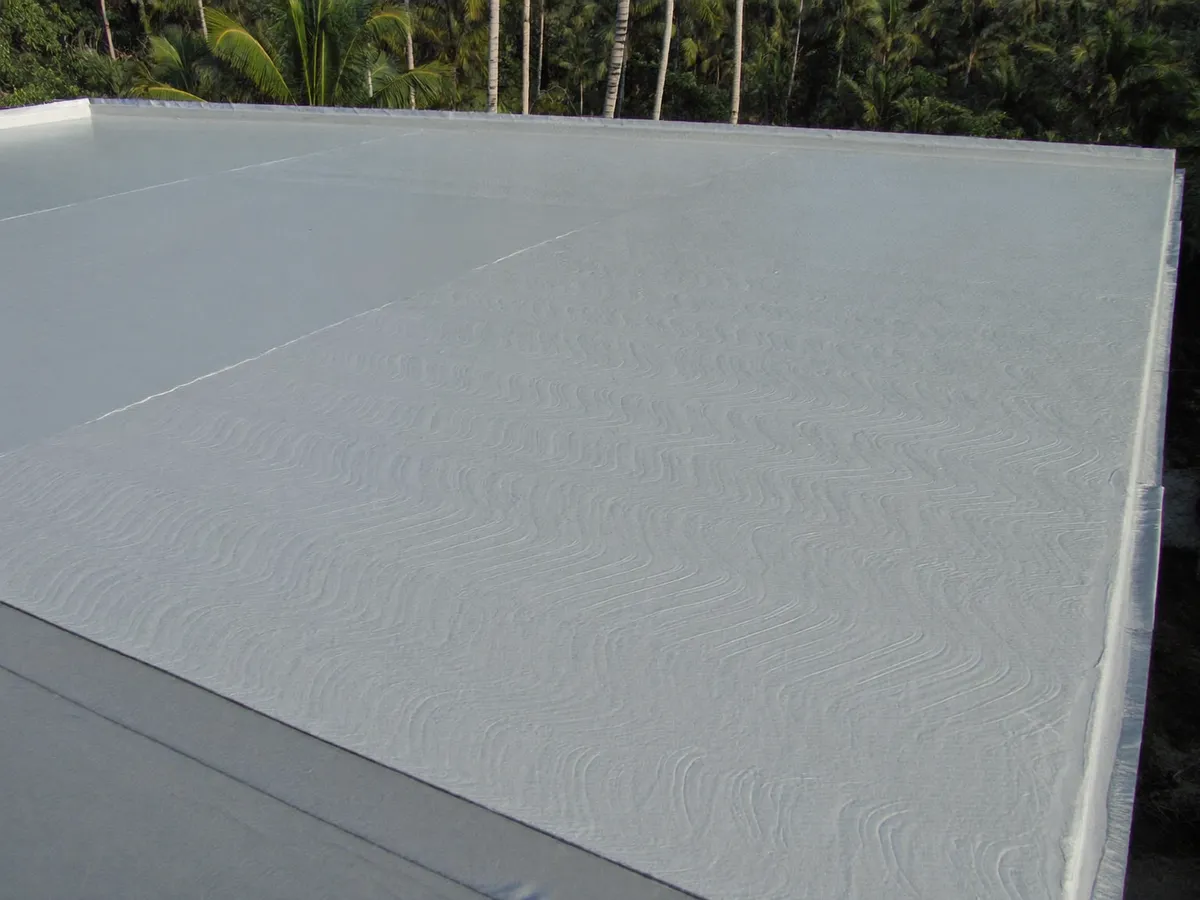
Short answer: most Bali flat-roof leaks start at drain outlets, parapet junctions and cracks — not in the middle of the membrane — and re-waterproofing a roof with PU liquid membrane costs IDR 260,000–420,000 per m² including substrate preparation. The most expensive mistake we see is a new membrane rolled straight over a failed one: it bonds to the old layer, not the concrete, and when the old layer delaminates it takes the new one with it. The repair that holds is to strip back to clean concrete, treat cracks and details, then apply the new system.
Why Flat Roofs Leak in Bali Villas
Drainage Outlet Failures
The most common failure point on Bali flat roofs isn't the membrane field — it's the drainage outlet. Where the membrane terminates and seals around a drain pipe, movement from thermal expansion and contraction creates micro-cracks over time. A pinhole leak at a drainage outlet can allow significant water ingress into the ceiling below while the main membrane surface remains visually intact.
Parapet Wall Junctions
Where the roof membrane terminates at parapet walls, it needs to be turned up the wall face by at least 150mm and protected by a counter-flashing or cap detail. Many Bali villa builds omit this detail or execute it incorrectly — leaving an exposed membrane edge that allows water ingress under the membrane at the perimeter before the field membrane has failed.
Thermal Movement Cracking
Bali's flat roof surface temperature ranges from below 25°C at night to 70°C+ on a sun-exposed black membrane at midday. This 45°C+ daily cycle causes the concrete substrate to expand and contract by 1–2mm per metre. Rigid waterproofing membranes without crack-bridging capability fracture at stress concentration points — corners, re-entrant angles, service penetrations — within 3–5 years under this thermal loading.
Poor Substrate Preparation
Membrane manufacturers specify a minimum tensile strength and surface condition for the substrate before application. Bali construction reality is that membranes are frequently applied over dusty, laitance-covered or incompletely cured concrete. A membrane applied to a weak substrate bonds to the surface layer only — which subsequently separates from the concrete below, carrying the waterproofing with it.
Roof Waterproofing Systems We Install
Polyurethane liquid membrane: joint-free application, excellent crack-bridging capability, UV resistant. Best choice for complex roof geometries with multiple drainage outlets and penetrations. Requires proper mixing and application temperature control. Service life 10–15 years with correct application.
Cementitious crystalline waterproofing: penetrates concrete capillaries and forms insoluble crystals that block water passage. Cannot be applied where there's active water flow, but once applied, is permanent — it's part of the concrete rather than a surface layer. Excellent for new construction; also usable for remediation of water-resistant concrete structures. Not suitable for roofs with movement joints.
APP modified bitumen membrane: torch-applied bitumen sheet with polyester reinforcement. High durability, good crack bridging, proven 20+ year performance. Requires torch-application skill and fire management on Bali's combustion-sensitive construction sites. Best for large flat roof areas with good substrate access.
HDPE sheet membrane: prefabricated sheet with heat-welded seams. Best performance for below-ground and water-retention applications. Requires specialist welding equipment and skill to install correctly. Overkill for standard villa roof applications but the right choice for basement slabs and below-grade retaining walls.
Before You Book: FAQ
How long does roof waterproofing last in Bali?
A correctly applied polyurethane or modified bitumen system on a properly prepared substrate should last 10–15 years in Bali's conditions. Systems applied over failed membranes or on poor substrates often fail in under 3 years. The preparation is as important as the product.
Can you waterproof a roof while it's raining in Bali?
No — most membrane systems require a dry substrate for adhesion. We schedule roof waterproofing during Bali's dry season (April–October) where possible, or work with forecast windows during the wet season. Application to damp concrete produces membrane delamination within weeks.
My roof leaks only during heavy rain. Is that a waterproofing issue?
Not necessarily — some heavy-rain-only leaks are drainage capacity issues rather than membrane failures. If the roof drains can't discharge water fast enough, it ponds to a depth that exceeds the membrane termination height at parapets or penetrations. We assess both membrane condition and drainage capacity when investigating rain-only leaks.
How much does a roof membrane cost per m² in Denpasar?
As a guide, PU liquid membrane re-waterproofing costs IDR 260,000–420,000 per m² including substrate preparation, and a walkable terrace membrane IDR 320,000–480,000 per m². The same rates apply across Denpasar and Badung; the final price follows a leak inspection (IDR 500,000–1,000,000, credited to the repair).
Can you fix a roof leak without re-coating the whole roof?
Often, yes. When the leak comes from a failed drain collar, a parapet junction or a single penetration and the rest of the membrane is sound, we repair that detail only. Re-coating the whole roof is only worth it when the membrane itself has aged or lifted across the field.
Our Roof Waterproofing Process
Diagnosis
We trace the actual water path — not just where it appears inside. Drain collars, parapet junctions, penetrations and the membrane field are each checked, because the visible damp patch is rarely directly below the entry point.
Substrate preparation
Failed membrane is stripped back to sound concrete. Laitance and dust are removed, and the surface is checked for the tensile strength the new system needs. This is the step most cheap repairs skip — and the reason they fail.
Crack and detail treatment
Movement cracks are bridged or injected, drain flanges re-bedded into the system, and the perimeter turned up the parapet wall behind a counter-flashing.
Membrane application
The specified system — polyurethane, modified bitumen or cementitious — is applied at the correct thickness in dry conditions, then inspected before any protection layer goes on.
Roof membrane prices in Bali (Denpasar, Badung) 2026
Guide prices per m² for flat roofs, roof terraces and concrete gutters. The same rates apply in Denpasar and across Badung — Canggu, Seminyak, Kuta, Jimbaran, Nusa Dua and Uluwatu — and in Ubud. The final figure depends on the old layer: a sound substrate can take a new system after cleaning and priming; a delaminating one has to come off first.
| Service | Guide Price (IDR) | Notes |
|---|---|---|
| Roof leak inspection & diagnosis | 500,000–1,000,000 | Credited toward the repair if we do the work |
| Small membrane repair (under 1 m²) | 750,000–1,200,000 | Clean and patch |
| PU liquid membrane re-waterproofing (per m²) | 260,000–420,000 | Substrate prep included |
| Terrace / balcony membrane, walkable finish (per m²) | 320,000–480,000 | Foot-traffic rated top coat |
| Torch-on bitumen (APP) sheet (per m²) | from 200,000 — guide | Large open roofs; confirmed after inspection |
| Cementitious flexible membrane (per m²) | from 150,000 — guide | Gutters, planters, under tiles |
| TPO / PVC sheet membrane | by quote | Rare on Bali villas; on request |
The first step is always the inspection: we trace where the water enters, not just where it shows, and give you a written scope. If we do the repair, the inspection fee is credited to it. Rates for bathrooms, pools and basements are on the waterproofing price list.
Flat roof leak repair before the rainy season (Oct–Nov checklist)
Bali's wet season usually arrives in November. Membranes need a dry substrate to bond, so October is the last comfortable window to fix a flat roof properly. Walk your roof with this list — anything you tick is worth a photo:
- Drains and gutters. Clear every outlet and concrete gutter. After rain, water should be gone within an hour; puddles that sit longer mean ponding, and ponding finds every pinhole.
- The membrane surface. Bubbles, cracks, chalky or hollow-sounding areas mean the membrane is ageing or lifting from the slab.
- Parapets and cappings. Cracked cap tiles and a membrane edge that is not turned up at least 150 mm behind the capping let wind-driven rain in at the perimeter.
- Penetrations. Pipes, AC brackets, water-tank stands and solar mounts — each needs a sealed collar, not a blob of cement.
- Inside the house. Old stains on ceilings under drains or at the top of walls tell you where last season's water came in.
- Timing. Book the repair while the slab is dry. Once the rains start, emergency containment is still possible, but a full re-waterproofing waits for dry spells.
Why leaks appear only with the first storms is explained in why Bali roofs leak in the rainy season.
Related Services
If your leak is below the roof rather than in it, see bathroom waterproofing, pool waterproofing or below-ground systems. Not sure which type of leak you have? Our guide on the 4 reasons Bali roofs leak helps you narrow it down.
Areas Covered
Roof Leak in Bali?
Tell us where the water appears and we'll advise the fastest diagnostic approach. Most roof leak sources can be narrowed down from a description before a site visit.
WhatsApp for Roof Waterproofing